Procurement Lifecycle
Procurement Lifecycle
Through the competitive bid process, as detailed in the Montana Procurement Manual, the State of Montana ensures that all suppliers have equal access to conducting business with the State. The State’s procurement process falls into the Procurement Lifecycle, beginning when a State Entity first identifies a need for goods or services and continuing through identifying existing suppliers, posting solicitations through the competitive bid process, awarding a contract, and contract management. The following are the eight phases of the procurement lifecycle.
The first phase of the Procurement Lifecycle is to identify the goods or services needed by the State. This includes determining how much is needed and any additional functionalities and features that should be included.
Resources:
The second phase of the Procurement Lifecycle is the selection of the method of procurement. The purpose of this phase is to determine the appropriate procurement method to obtain the desired goods or services based on the estimated total contract value, characteristics, constraints, and risks. For example, if the cost is the paramount consideration for the award, an invitation for bid may be used. The Contracts Officer will determine the proper procurement method after consultation with the agency.
The third phase of the Procurement Lifecycle is the development of the solicitation; contract management also starts in this phase.
Solicitation refers to an invitation for bid, a request for proposal, or any other document issued by the State to solicit bids or proposals to enter into a state contract. Decisions made while developing the solicitation will influence the contract management phase considerably. This phase involves developing the official solicitation document, which includes the specifications or scope of work, the appropriate terms and conditions, evaluation criteria, and other pertinent information. This phase is where the draft contract is developed and later used for the award phase.
Resources
- Federal Terms & Conditions - Standard*
- Invitation for Bid (IFB) Template
- Intent to Sole Source
- Limited Solicitation (Verbal Quote) Template
- Limited Solicitation (Written Quote) Template
- Pre-Bid/Proposal Conference Guidelines
- Q&A Document (Sample)
- Request for Information (RFI) Template
- Request for Proposal (RFP) Process
- Request for Proposal (RFP) Check-Off List
- Request for Proposal (RFP) Template
- Sole Source Justification Form
- Sole Brand Justification Form
- Standard Terms & Conditions (RFP)*
- Standard Terms & Conditions (IFB)*
- Contract Template*
- Guideline for Statements of Work*
- Lease Finance Master Agreement*
- Lease Finance Schedules*
- Performance Bond Template*
- Purchase Order Template*
- Purchase Order Template, Non-IT Purchases
- Software License Agreement Template*
- Statement of Work Task Order (Sample)
- Statement of Work Template
- Prevailing Wage Questions and Answers
- Tier II Solicitation Procedure – General
- Contractor Engagement Proposal (CEP) Checklist
- Contractor Engagement Proposal (CEP) Cover Sheet & Proposal Instructions
- Contractor Engagement Proposal (CEP) Position Description Template*
- Contractor Engagement Proposal (CEP) Position Description Example*
- Tier II Environmental Services Procedure
- Tier II Environmental Services Checklist
- Tier II Environmental Services Cover Sheet & Instructions
- Tier II Ecological Restoration Services Procedure
- Tier II Ecological Restoration Services Checklist
- Tier II Ecological Restoration Services Cover Sheet Instructions
- Tier II Ecological Restoration Services Model Task Order*
- Tier II IT Service Procedure
- Tier II IT Services Checklist
The fourth phase of the Procurement Lifecycle is the evaluation process. This phrase begins after the State has solicited bids or proposals, and vendors have provided responses. The Procurement Officer and, if required, the evaluation committee reviews answers from the vendors to determine their responsiveness or compliance with the requirements in the solicitation. Then it is determined which vendor will be awarded the contract based on predetermined evaluation criteria provided in the solicitation.
Resources
- Non-Disclosure and Conflict of Interest Certification
- Reference Check Form (Sample)
- Scoring Guide (Sample)
- Cost Evaluation Examples
- Guide for Identifying & Handling Confidential Information
- State of Montana Ethics Policy (Copy)
- Contractor Engagement Proposal (CEP) Evaluation Criteria
- Contractor Engagement Proposal (CEP) Scoring Matrix
- Tier II Environmental Services Evaluation Criteria
- Tier II Environmental Services Scoring Matrix
- Tier II Ecological Restoration Services Evaluation Criteria Outline
- Tier II Ecological Restoration Services Scoring Matrix
The fifth phase of the Procurement Lifecycle is the notice of intent to award and contract negotiations.
Once the winning vendor is selected in phase 4, a Notice of Intent to Award (NOIA) is posted to the public bids site. The NOIA includes the following pertinent information.
- Solicitation Title/Event Name
- Solicitation Number
- Solicitation Close Date
- Notice of Intent to Award Posting Date
- Issuing Contracts Officer/Contact Information
- Apparent Successful Offeror(s)
- Unsuccessful Offeror(s)
- The final bid tab or scoring matrix
The NOIA will be open for a 7-day period prior to contract award. During this period, comments from the public regarding the proposed award may be submitted to the Contracts Officer listed. Once the NOIA is posted, solicitation documents are available for inspection upon request subject to 18-4-304, MCA, and 18-4-126, MCA.
Before a contract can be finalized, the agency may have the ability to refine the agreement with the awarded vendor. This phase provides an opportunity for the parties to negotiate non-material changes to a contract’s terms and conditions.
Resources
The sixth phase of the Procurement Lifecycle is the formation and award of the contract. Once the NOIA has been posted for the required 7-day period and all negotiations have been completed, the contract can be finalized and awarded. Finalized and awarded indicates the acceptance of a bid or proposal through a formal agreement or signed contract.
Resources
- Federal Terms & Conditions – Standard*
- Standard Terms & Conditions (RFP)*
- Standard Terms & Conditions (IFB)*
- Contract Template*
- EULA Amendment One Template
- Guideline for Statements of Work*
- Lease Finance Master Agreement*
- Lease Finance Schedules*
- Performance Bond Template*
- Post-Award Conference Agenda (Sample)
- Purchase Order Template*
- Purchase Order Template, Non-IT Purchases
- Software License Agreement Template*
- Verification of License of Surety Company
- Contractor Engagement Proposal (CEP) Position Description Template*
- Contractor Engagement Proposal (CEP) Position Description Example*
- Tier II Ecological Restoration Services Model Task Order*
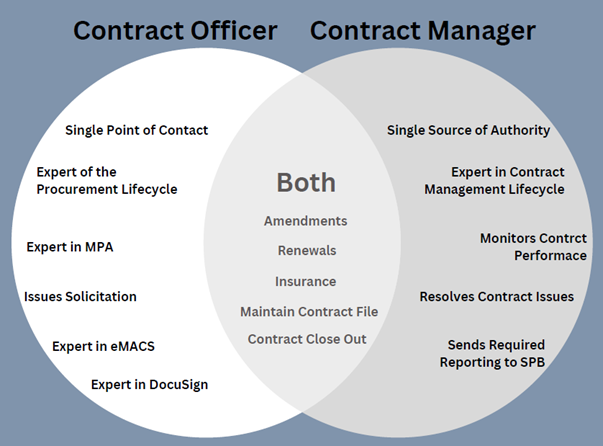
The seventh phase of the Procurement Lifecycle is contract administration. The Contracts Officer is responsible for overseeing the procurement lifecycle and will work with the Contract Manager to manage and maintain the contracts.
Resources:
The eighth and final phase of the Procurement Lifecycle is the contract closeout. The Contract Officer and the Contract Manager work together to complete the contract closeout. The contract closeout provides a record for the contract end of life that provides the following information.
- The term of the contract and whether it was closed at the end of life or terminated early.
- All issues reported during the life of the contract and the resolution, if applicable.
- Payments.
- Any reporting as required by law.